


Typically, in Europe and the USA, a kerb is accompanied by a number of parallel lines close together. Weak perspective projection is a good approximation to perspective projection in this case as the variation in depth of the scene is small compared to the depth along the line of sight. As a result, parallel lines in the world project to parallel lines in the image, so we can use the Hough Transform [ 12 ] to detect clusters of parallel lines in the image as evidence for a kerb. As we do not need disparity information, we just consider a single image. The flow diagram is as shown in Figure 1 .

Figure 1:
Canny edge detection and Hough Transform kerb finding
Since kerbs are usually long, we model them as infinite lines. For point , the quantised Hough space is
 where
where is the angle rotated, and
r
is the distance from the origin of the x-y coordinate system as shown in
Figure
2
. We have
is the angle rotated, and
r
is the distance from the origin of the x-y coordinate system as shown in
Figure
2
. We have

where W is the dimension of image.
We accumulate evidence for straight lines from the set of detected edge
points obtained from the Canny detector. Then we extract the small
number of s which receive most support. From these straight lines, we search for
clusters of at least three parallel lines which are close together, and
return
s which receive most support. From these straight lines, we search for
clusters of at least three parallel lines which are close together, and
return for the kerb region perpendicular to slope
 extending from
 to
to as shown in Figure
2
. This gives the estimated position of the kerb region.
as shown in Figure
2
. This gives the estimated position of the kerb region.
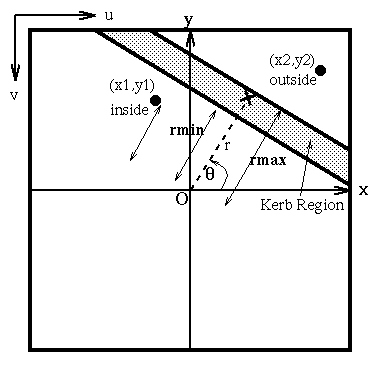
Figure 2:
Geometry for edge point classification
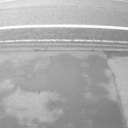
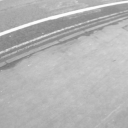
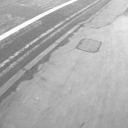
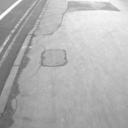
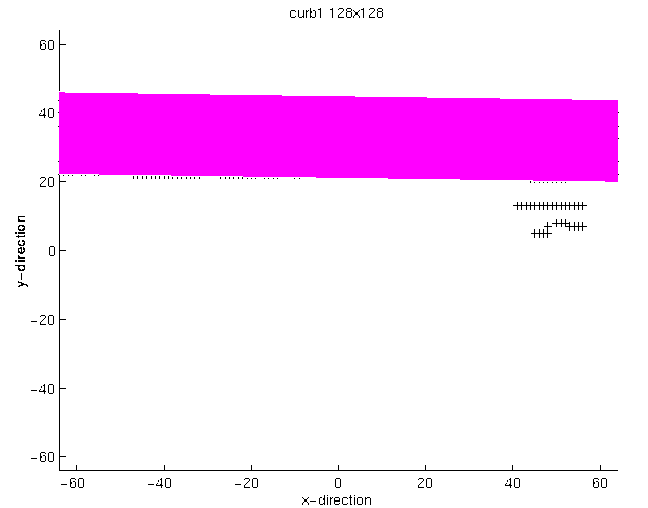
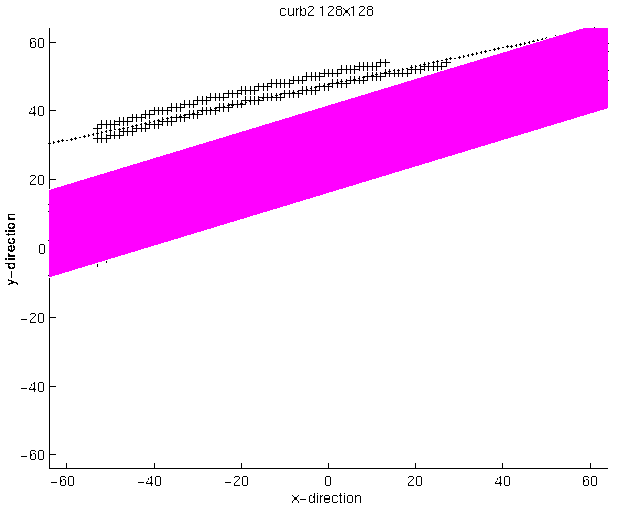
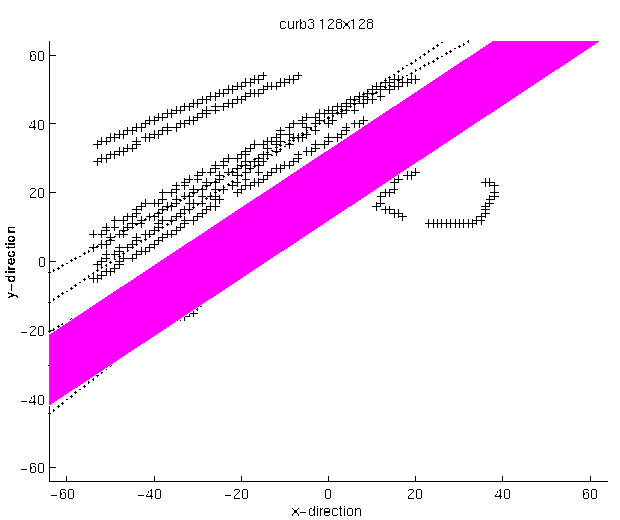
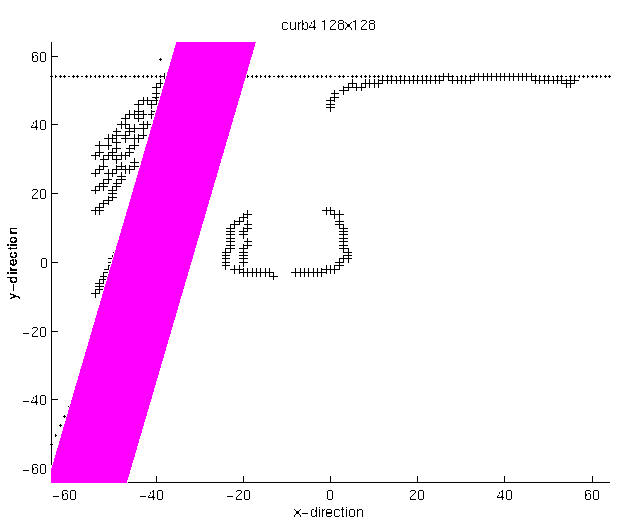
Figure 3 shows some images of the same kerb viewed from various angles. Figure 4 shows the kerb regions found.
|
|
|
|
|
|
|
|
Stephen Se