


GPOD parameterises the ground plane using measurements of disparity. It includes an initial calibration stage in which the ground plane parameters are extracted from images of the ground containing line features but no obstacles. It then compares the disparity values in a new image pair with the expected ground plane disparity to detect differences (hence obstacles). The ground plane disparity d varies linearly with cyclopean image plane position [ 6 ], that is
where is the cyclopean image coordinates.
We obtain a least-squares fit for the ground plane parameters by orthogonal regression. However, as the image coordinates and the
measured disparities are not noise-free, we study the covariance of the
by orthogonal regression. However, as the image coordinates and the
measured disparities are not noise-free, we study the covariance of the estimate because this tells us how much confidence we can have in our
ground plane estimate.
estimate because this tells us how much confidence we can have in our
ground plane estimate.
Re-arranging Equation 1 , we have au+bv-d+c=0 , and so we minimise

where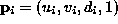 and
and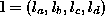 . The ground plane parameters
 are obtained as
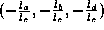 . This problem is equivalent to

subject to

in which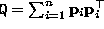 , i.e.

The Lagrangian for this is given by

Setting , we have
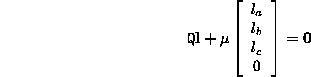
The solution for is the eigenvector corresponding to the least eigenvalue of the matrix

and

where denotes the
 element of matrix
 .
.
The estimate of gives
gives . Now we need to analyse the covariance of
 . To do this, we follow the technique outlined in Faugeras [
3
] (pages 151-158) for the constrained minimisation case. Assuming that
. To do this, we follow the technique outlined in Faugeras [
3
] (pages 151-158) for the constrained minimisation case. Assuming that has been obtained by minimising the criterion function
 subject to the constraint above, this defines implicitly a function
 such that
 in a neighbourhood of
 .
.
We define the vector by
by
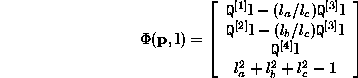
where denotes the
 row of matrix
 . The Jacobian of
 is given by

Assuming that the error at each point is independent and that the errors
are isotropic, the covariance matrix for the original data is block diagonal in form with
 's covariance matrix as the
 block, assuming all points have the same diagonal covariance matrix,
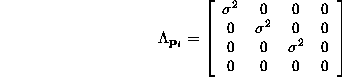
The covariance matrix for is given by

The ground plane parameters are obtained as
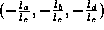 , in which
 is always close to unity and its variance is smaller than those of the
others by a magnitude of at least 2. For this reason, we take the
variances for
a
,
b
and
c
to be
is always close to unity and its variance is smaller than those of the
others by a magnitude of at least 2. For this reason, we take the
variances for
a
,
b
and
c
to be ,
, and
and respectively [
1
].
respectively [
1
].
From Equation
1
, we can now determine the disparity variance, using the error
propagation formula for the product of two uncorrelated distributions [
1
] given by . We find that the expected disparity is
Stephen Se

